Bear River Nova Scotia

All posts tagged Bear River Nova Scotia

Signs of Spring: revised

Published April 21, 2012 by oddacity designs

Spring is really happening in Bear River!  Here are a few of the tell-tale signs.

This slideshow requires JavaScript.

Village News: As it Happens: April 7/13

Published April 7, 2012 by oddacity designs

.

Happy Birthday this month to Roz Rice who is turning 80!  To celebrate there will be an open house birthday party at the Advent Christian Church on April 28, from 2 to 4, with refreshments served.  All of Rosalinds’s friends are welcome to attend!

Myrtle and Rosie’s has expanded! That’s right, the space formerly occupied by Kelly Foxton’s Trading Post is now part of the kitchen, making much more room in the previous space for tables and merchandise.  Drop in and see how great it looks.

Tim Wilson is back in Bear River after a long absence.

Good News! Raine Ryan, daughter of Shyla Harris and Cody Ryan, is off the critical list and doing well.  The hope is that she will soon be strong enough for surgery.

We are sorry to hear that Mike Corbett has moved way down the valley. While Noreen Millar and Erin  have moved from town they are still nearby in Clementsport.

The former location of the Bear River Bargains and Books won’t be empty for long.  Mark Jacques will be opening up his upholstery shop there in the near future. Mark is the son of Stan and Alice Jacques who operated SAM Upholstery for many years, and Mark has been running the business for some time now in Clementsvale.

The Scotch Doubles pool tournament in Annapolis Royal last weekend saw a couple from Kingston walk away with first prize, but second place and $200.00 went to Fred Miller and Andrea.  Well played!

And more about pool: Sunday, April 15 is the day for the Tommy Thibeault Tournament at the Bear River Legion. Last year’s winners, Todd and Sam Sloane will be trying to hold on to the trophy against some stiff competition.  Good Luck to Everyone!

Phyllis Read is enjoying the company of visiting family over the Easter weekend.

Kyle Ellis is happy to be spending the Easter weekend with his mother, Teresa Henshaw,  and a great Easter dinner with the family around the dinner table.

Congratulations to Eric Cox, who won the draw for the quilt at the Bear River Health Clinic.

And for all of you waiting desperately to hear the latest whereabouts of Francois Bellefontaine, we are happy to announce that his latest trip had him touring the countryside of Portugal.

Happy Easter to All.

History and Stories of Bear River: Ethel and Ancil Ellis

Published April 3, 2012 by oddacity designs

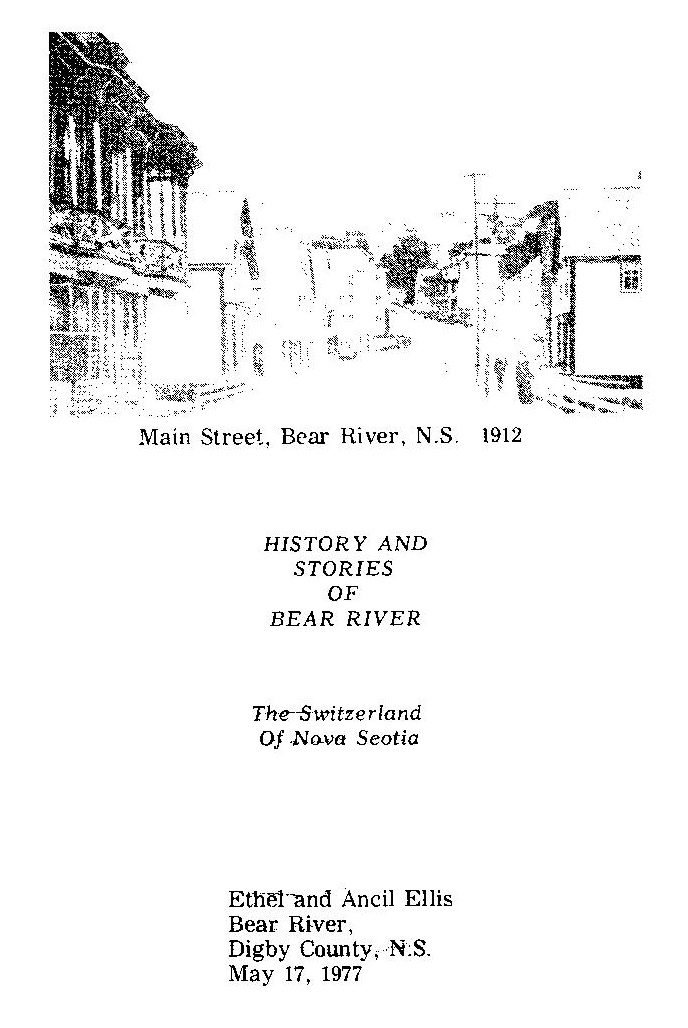
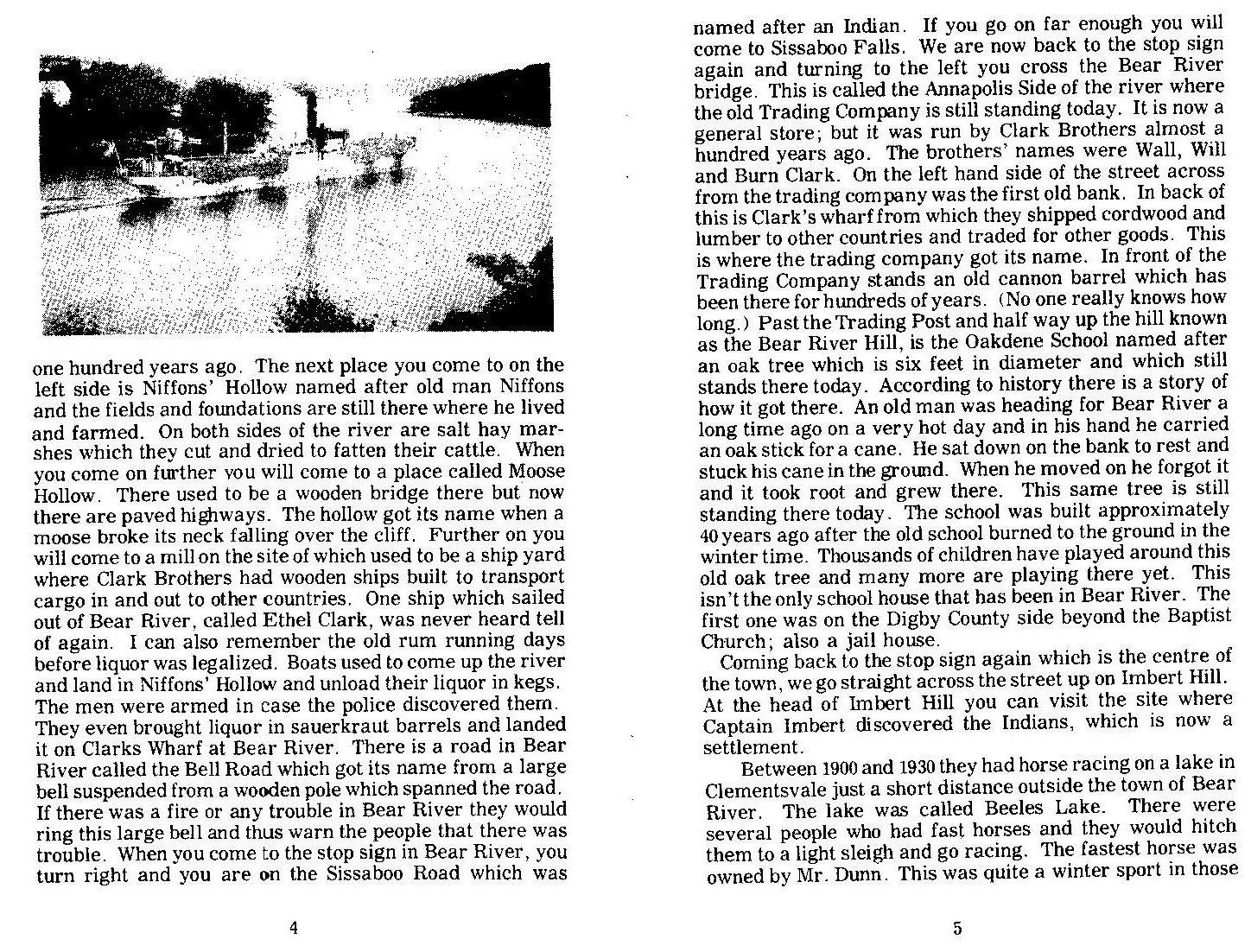
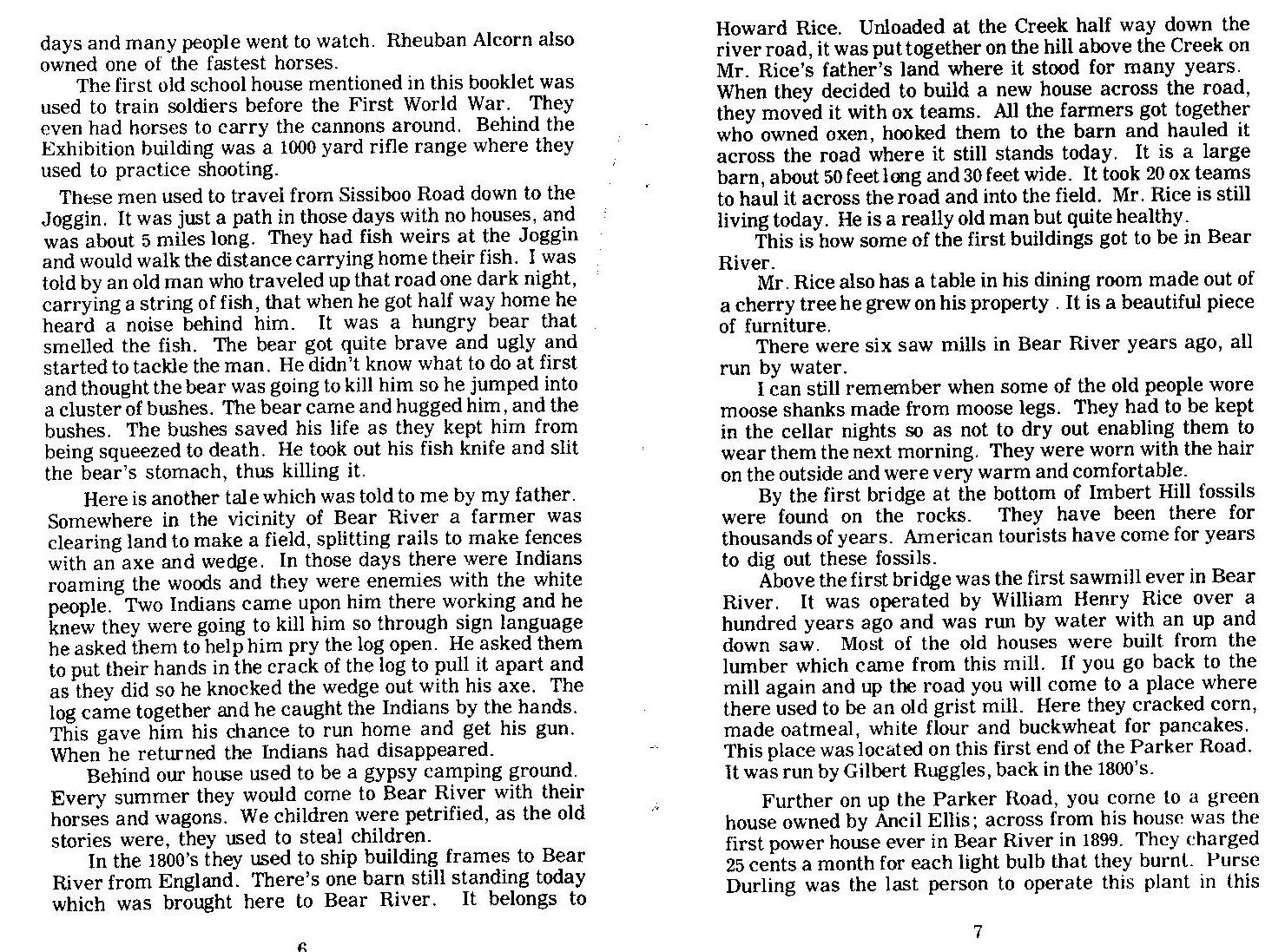
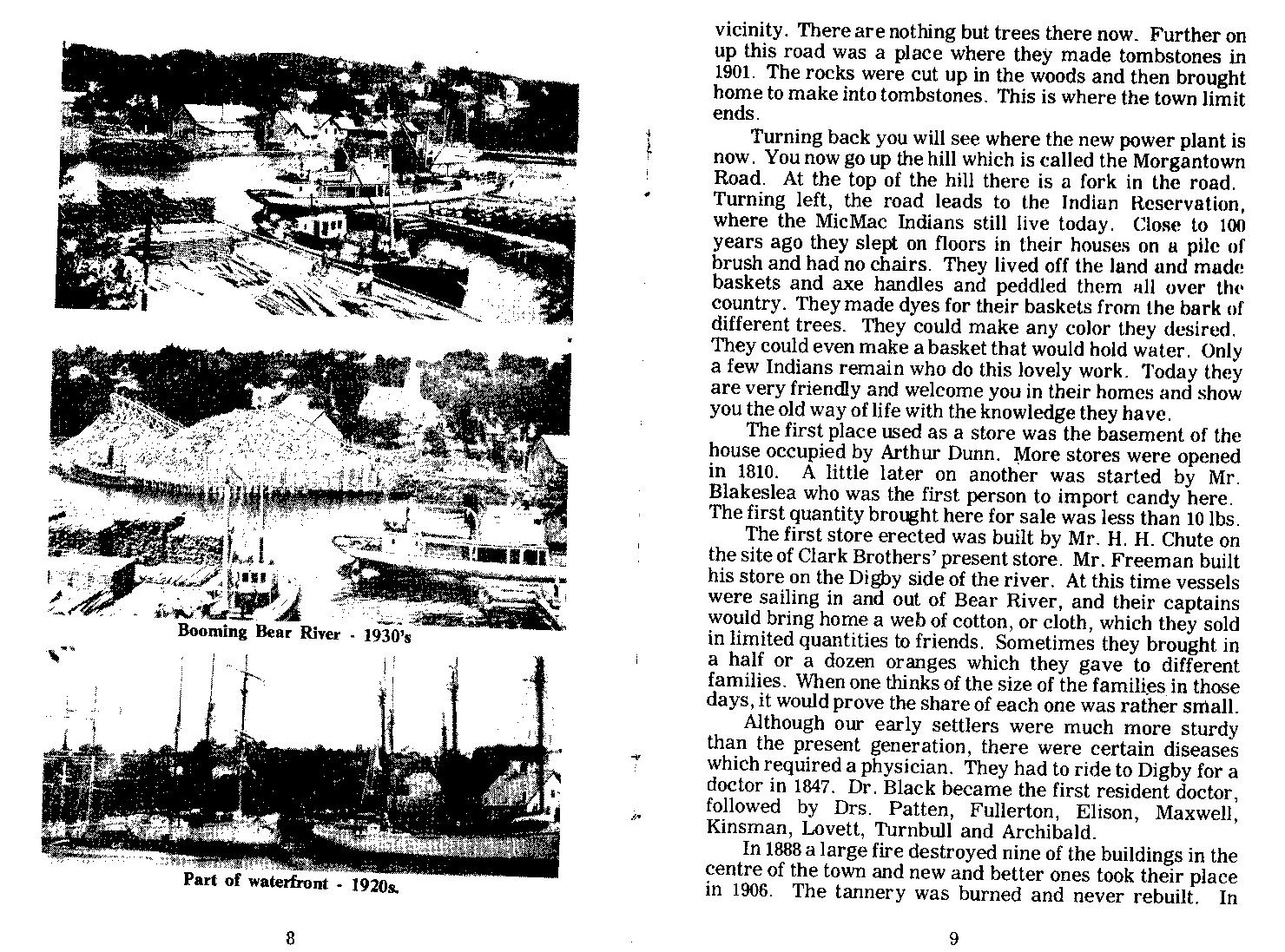
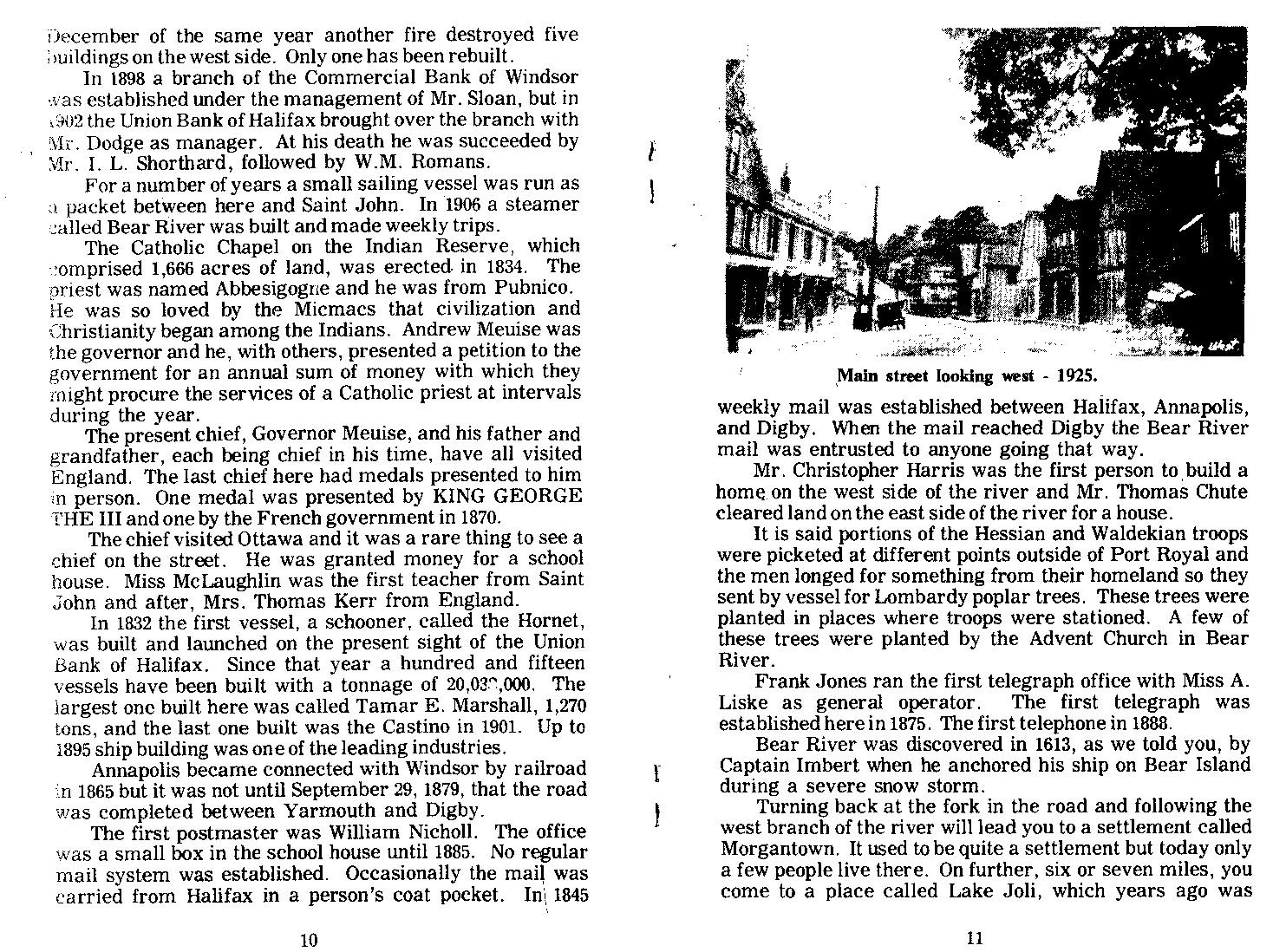
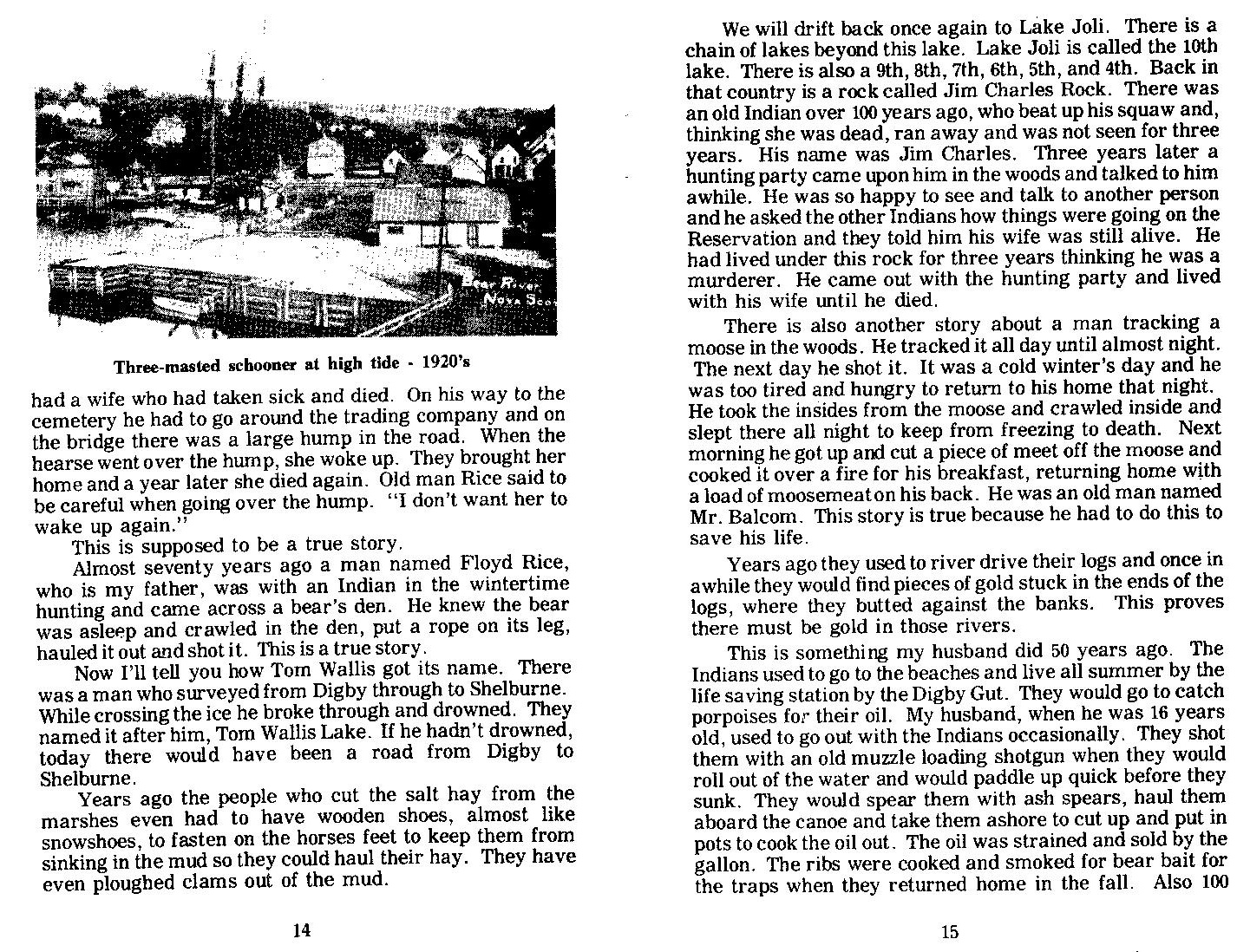
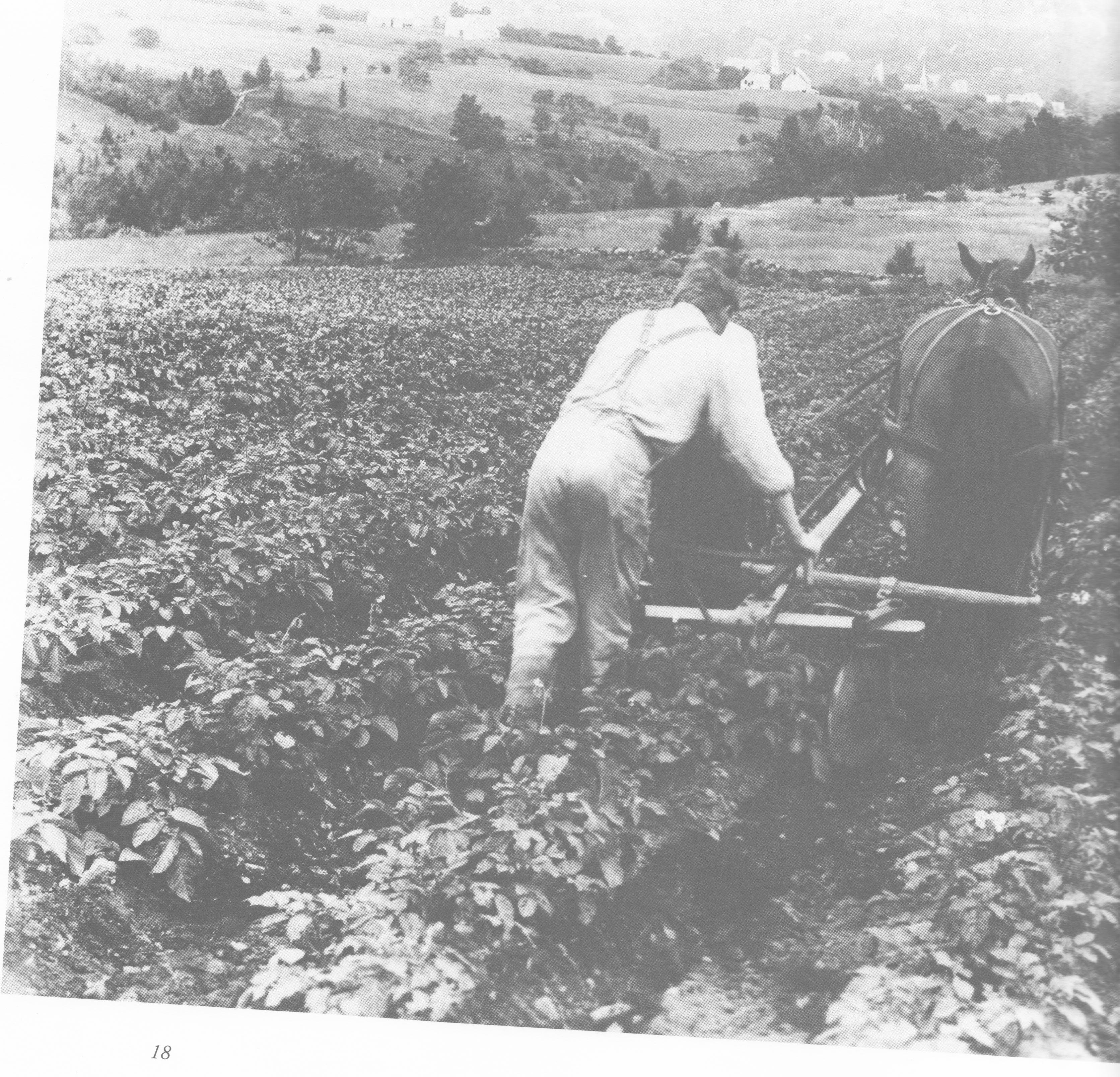
The most recent pamphlet we can find written by a resident of Bear River about the village is “History and Stories of Bear River, The Switzerland of Nova Scotia.”  

This wonderful glimpse of the village, complete with photos, was written in May,1977.  Here is it reproduced digitally for your enjoyment. Click on image to enlarge.

Unfortunately Ancil and Ethel Ellis have both passed on,  but with enough encouragement, maybe another “old timer” will tell you a few stories.

Bear River History from 1893

Published April 2, 2012 by oddacity designs

The document reprinted here has no identified author.  If anyone has any ideas as to who it was written by, please let us know.

Nestled among the hills, along both sides of the stream which for some distance forms the boundary lines between the counties of Annapolis and Digby, stands the bustling, enterprising community, which, collectively, is known as Bear River.  The parts on each side of the river belong to different municipalities, and in some respects, diverse interests.  A few years ago an attempt was made to complete the diverse between the two sections  of the town by giving to each a distinct name, that part on the Annapolis side being called Bridgeport, and that on the Digby side, Hillsburg.   But this attempt to diverse what nature had joined together proved abortive, and these names are now seldom heard, while the general name used to designate both communities as one town remains fixed, doubtless, permanently.  If we mistake not, the sections on each side have formed a union for educational purposes, and at their present rate of progress, the community of interest existing between both, may draw them into more complete union, of a municipal  nature, at no very distant day.

The stream divides the two sides; foreground, Bridgeport, background, Hillsburg

Several explanations have been advanced as to the derivation of the name of this town. A recent writer claims its origin as derived from the French pronounciation of Imbert, a gentleman who formed one of the party visiting this spot as early as 1611.

From the date of the French occupation of the country, 1604, to the date of their expulsion  in 1755, it is believed that no settlement was made as no remains have been found on which to ground an opposite assertion, and the town is, doubtless, of exclusive English origin.  With the invasion  of the United Empire Loyalists, the settlement of the district commenced, and in 1784, the township of Clements, including both sides of the stream, was granted to certain English, Hessians, and Waldeckians who had served during the old revolutionary war, and who, at its close, received grants of land, in lieu of pay for the services they had rendered in that unfortunate struggle.

The first frame house was erected by one Capt. O’Sullivan Sutherland, and stood nearly midway up the slope of the eastern hill, and adjacent to the present residence of Captain J.Harris.  The housewarming, given on the occasion of the completion was a merry-making of no ordinary description. Everybody who was entitled to be somebody was invited and music, dancing and drinking made the hours reseate until the dawn of the next day.  Among the guests were the Demoliters, the Hertricks, Kyshes, Callecks, Vreens, Ditmarses, Boehlers, Purdys, Joneses and others whose names do not now occur to our memory.   Perhaps there has been not so jolly a party in the place from that day to this.

Before the completion of this first framed dwelling,  a number of log huts had been built and occupied by both German and English settlers, and the work of clearing the soil for cultivation had commenced, but with so little success owing to the ignorance of the proprietors, that much want and suffering was felt by their families  for several years to come.

Towards the close of the century, there was considerable movement from the townships of Granville and Annapolis, to the hill country on the shores of Bear River.  At was at this period that the Clarkes, the Millers,the Troops, Dodges, the Rices, the Chutes and the Harrises bought lands and settled in the district, a course they were induced to take in the belief that wheat and other cereals could be produced in larger quantities and of finer quality there than could be raised on the same sized areas elsewhere in the county, and  the descendants of these men today constitute a large percentage of the population, both of the village and its immediate vicinity.

early farming in Bear River

Still, up to the  date under review, 1790 to 1810, there had been no village visible, but soon after sawmills began the work of  transforming the timber up the streams into lumber, necessitating the inception of shipbuilding, which was almost contemporaneously begun, stores were erected, and a thriving town was the final result.  No less than seven or eight public highways  converge upon the present town from different directions, and not an hour passes without the arrival of vehicles laden with freights for export or passengers on business or pleasure. Substantial and comfortable dwellings line the hilly streets in all directions, which at every point new aspects in landscape scenery.  Neat fruit and vegetable gardens and lawns are attached to nearly every domicile in the town and thrift and comfort everywhere give evidence of vital existence.

freight arriving in Bear River?

Today, the greater number of stores are on the Annapolis side, where Clarke Bros. have become the leader in Bear River in business matters, although there are a number of new and well furnished ones on the west side of the river.

The jewel of the Clarke Brothers commercial empire

The town also has fine places of worship, the Baptists being the leading denomination.  Within the past year, they have remodeled their church, making it one of the handsomest in the town.  The Methodists and adherents to the English church have each neat pretty religious edifices on the north side of the river, and the Adventists have also a house of worship.

left to right: Anglican Church, Oakdene School, Methodist Church

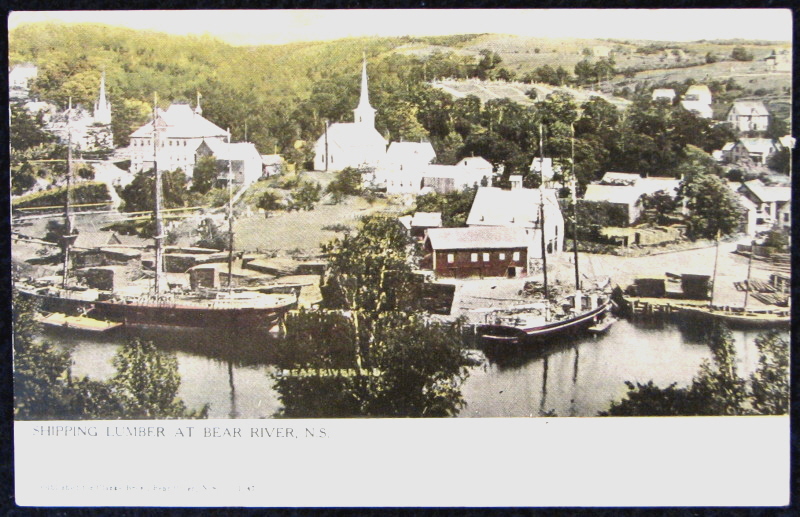
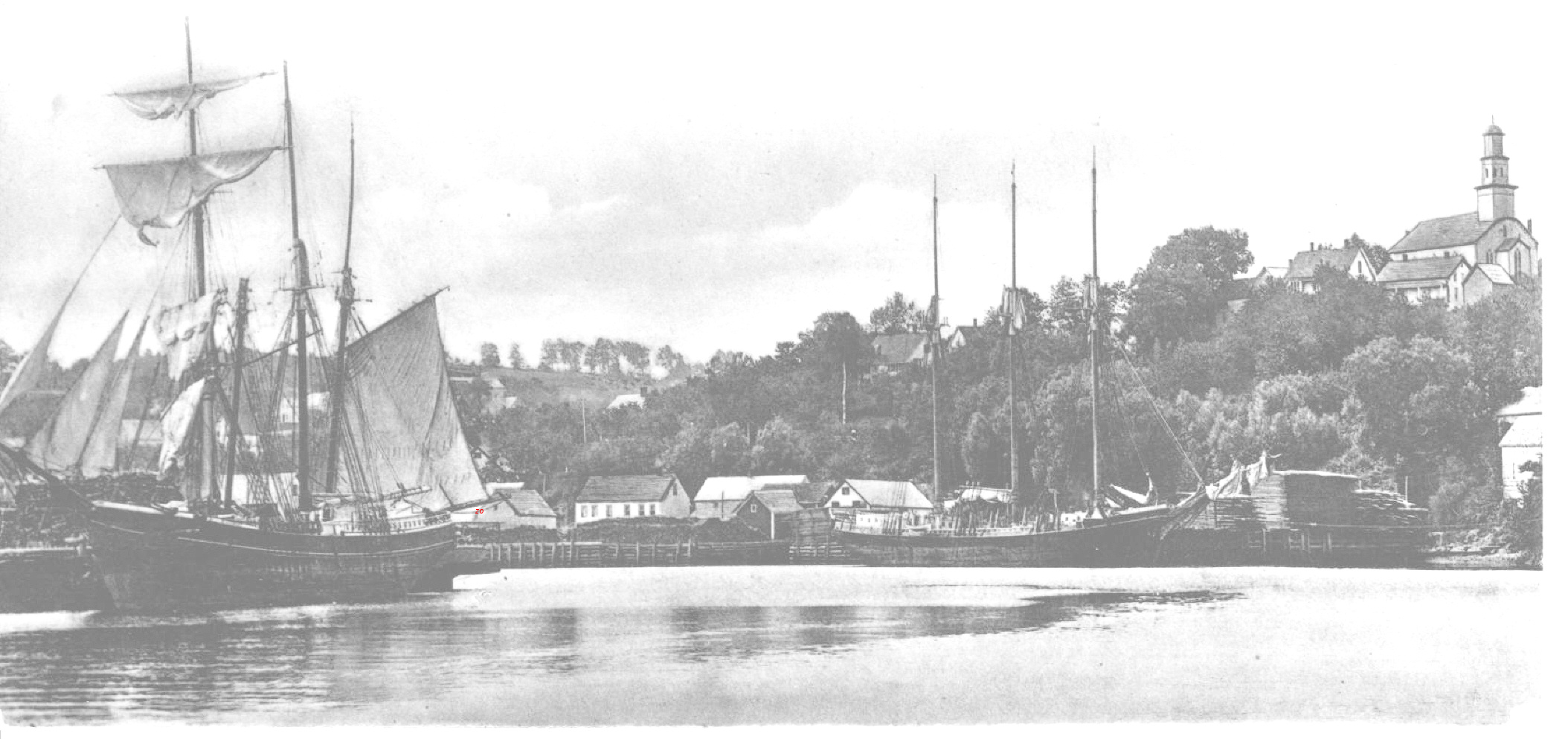
Bear River has sent from its shipyards many vessels, some of large tonnage, constructed by such efficient master builders as Mr. Thomas Rice, Captain John Benson, the Lents, and others which carried away freights of lumber , cordwood, pulpwood, and other products of the forests, for which it is noted , to ports in the United States, the West Indies, etc., and commanded by our skillful and intelligent native captains.

loading the ships with Bear River lumber

This delightful resort among the hills has also gained a deal of notoriety owing to its mammoth yield and great variety of cherries, and is visited, during the season, by excursionists from distant parts of the counties of Annapolis,  Digby,  and elsewhere, to enjoy to their heart’s content, a feast of the luscious fruits.  Besides the hundreds of others, here and there may be seen a majestic cherry tree planted by the French during their occupancy in the country, which serve as historical landmarks to that period.

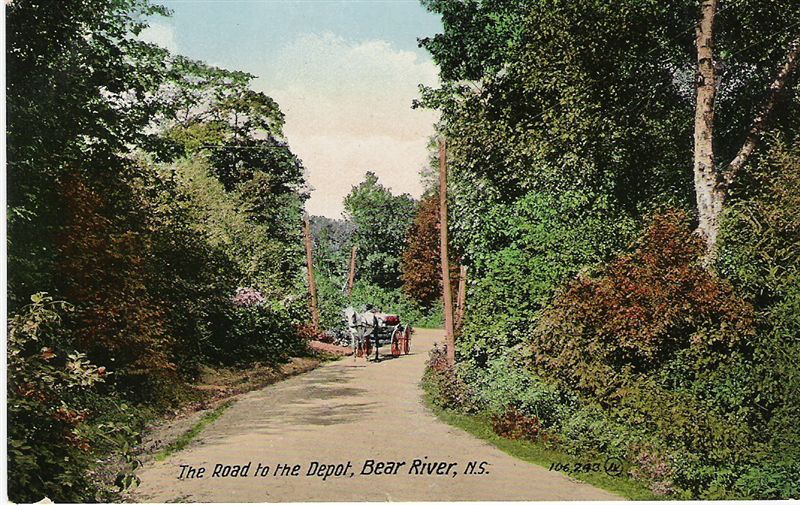
The construction of the so-called missing link of railway from Annapolis to Digby, and the building of a new highway from the town to the depot, located some four miles distant, proved a great boom to the commercial interests of the entire locality, affording as it does more direct communication with the principle avenues of travel.

Within the past year, electric light has been introduced, driven by one of the best water powers to be found in the country, while the many other improvements in the way of new dwellings, a $7000. schoolhouse and other evidences of prosperity and wealth mark the town  as one of the most progressive in the western part of the province.

Village News: As it happens: April 2

Published April 2, 2012 by oddacity designs

The Bear River Tides is published at the beginning of each month, but a lot of folks just don’t want to wait that long between thrills.  So here you will find out what’s going on, without losing your patience!

The Loss of a Legacy

April 2:  Unfortunately it wasn’t an April Fool’s joke when the Hillsburgh United Church was decommissioned on April 1st, ending a long history in the village.

From Lennie Wade’s Historic Glimpses of Picturesque Bear River:                 The first Methodist Church was built almost on the site of the present one, in 1837, and was used until 1859 or 1860 when the present one was erected.  The old building was moved up on the Chute Rd, next to the home of H.N. Chute, where it still stands (1) used as a dwelling home. Until 1860, this church belonged to the circuit of Annapolis, which was extended from Digby to Horton, but in that year it became an independent circuit and the ministers have been as follows: Rev. F.W. Pickles, R.Mason, J.S. Coffin, F. Harris, Wm. McCarty…….

a church no more

(1) The building at the corner of Clementsvale Rd. and Chute Rd. is the one referred to by the author. ( See tour of historic houses.)


******************************************

New Folks in Town

We welcome Ashley, Matthew Leonard and family to Bear River.  They are settling in to their new home, formerly owned by the Voleniks,  next to Mount Hope Cemetery.

********************

Check out the Commerce page for the most recent edition: Businesses from the Past.

Village news: March 20/21, 2012

Published March 20, 2012 by oddacity designs

The Bear River Tides is published at the beginning of each month, but a lot of folks just don’t want to wait that long between thrills.  So here you will find out what’s going on, without losing your patience!

March 21: 

Was it luck or skill that decided the winners of the recent Scotch doubles tournament at the Bear River Legion?  Walking away with the trophy were Squid Kennedy and Sean Andrews, while “Hoyt” Barry Frost and Steve Cole took the money and the turkeys.  Congratulations!

March 20:

Condolences to the family and friends of Robert Foster who passed away  recently in Massachusetts, surrounded by his family.  We will certainly miss his wonderful smile and positive attitude on life: and seeing him drive through town with the top down and the wind blowing through his hair.

*****************************

At the Bear River Board of Trade Annual General Meeting on March 19th, it was revealed that the Board of Trade will no longer run the Visitor Information Center, and is looking for ways to eliminate the burden of property” guardianship”, such as the waterfront park and the Green Lantern building.  Last year they went into debt by $5800, $3700 of which went to pay legal fees for Rick Jacques and unnecessary surveyors.

According to Rick Jacques, this year they will focus on raising money to get out of debt and rethink their reason for being.

Kelly Foxton has resigned as president, and there was no one to fill the position of secretary.  All members but one are either executive or directors.

The new president is Larry Knox.

Much more will be written about this in the upcoming weeks in thebearrivertides.com.

*************************

THE BIG MOVE

Bear River Bargains and Books is moving!  But don’t worry, Paul Volenik is not going far: just across the street to the Rebekah building, taking over the space being vacated by the Bare Canvas Gallery, which is no more.  He hopes to be settled in and ready for treasure hunters in April.

********************************

Home Again, Home Again

The good news is that Ginny and Emily Hurlock have returned safely from their travels in Costa Rica.  The bad news is that they didn’t get to visit the baby sloth rehabilitation center.  Oh well, maybe next year.

*********************************

Another First!

A huge congratulations to Teresa Dawson who has moved up to the rank of Second Lieutenant  at the Bear River Fire Department, making history as the first woman to do so!  Well done Teresa,  and keep up the great work.

***************************************

Settling In

Sharon Norton’s mother, Miriam Cuthill is settling in at her new home at the Annapolis Royal Senior’s Residence and is receiving visitors.  Sharon and Alf are regular visitors and enjoying the Newfoundland style music that is performed in the home regularly.

******************

How a Community Works

An amazing turnout for the benefit for Shayla Harris on Feb. 25,  brought in approximately $1900.00 to be used towards medical expenses for the upcoming baby. That’s the real Bear River that we know and love at work!

A big pat on the back for Donna Perkins who did the organizing of it all.

*********************

**********

Harry Hill: A colorful life

Published February 20, 2012 by oddacity designs

Harry Hill    1913-2005

by Angela McMullen

Anyone privileged to have known Harry Hill of Bear River cannot help but smile when hearing his name. This charming sage was a member of the community for ninety-one years, leaving behind a loving  legacy for future generations. 

He was so highly respected, that following his death, a monument was erected in the village waterfront park in his honor. Many family members, friends, village residents and political figures gathered to honor the man who made such an imprint on our village.

The story of Harry Hill begins after the American Revolution, when the government granted his Black Loyalist family a parcel of land in nearby Greenland.One of sixteen children, Harry was born to Benjamin and Blanche Hill. Together, the Hill family worked their land and lived off of its abundance. 

With a grade nine education, he left school to work at Cunningham’s Mill at the head of the tide. Harry held various employment positions throughout his life, each one attended to with pride, honesty and dedication.   

In addition to working at the Mill, he was the janitor at Canada Post for thirteen years. He was also the caretaker of Mount Hope Cemetery, where he maintained the grounds and dug graves for thirty-nine years, a position which he held until age eighty.

 Admired for his exceptional work ethic, Harry was an individual who had learned to balance work with pleasure. It can be said that Harry was the backbone of the community. His passions included singing in the choir at the Advent Church, and engaging the youth of the community to participate in various activities. 

He was the coach of the girls’ softball team for over a decade, and operated the skating rink behind the Fire Hall for eighteen years. Many residents fondly remember Harry tying their skates as children, and even teaching them how to skate. He was so committed to this cause, that he often spent time at the rink late into the night making ice.

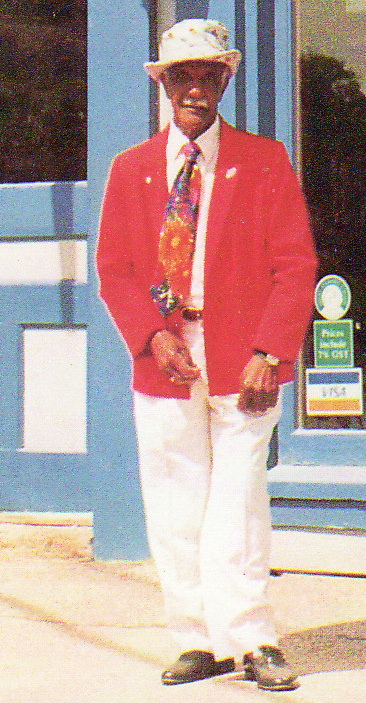
 Harry is affectionately remembered for his extraordinary fashion sense. When asked to describe Harry Hill, a local resident respectfully  said, “He looked like a peacock.” She was referring to the flamboyancy of his attire. 

Harry in one of his favourite outfits.

An enjoyable out-of-town excursion for Harry involved traveling to Halifax on the train, where he visited family and shopped for additions to his colorful wardrobe. Making his way up the aisle of the train, he introduced himself to the passengers with the tip of his fedora and a friendly handshake. “Harry Hill of Bear River.” 

A merchant at a particular clothing outlet in Halifax was so impressed with this country gentleman that he extended him credit, allowing him the opportunity to pay for his purchases at his leisure. 

Although Harry was a busy man, he took the time to acknowledge everyone, entertaining tourists with stories of his town and giving advice to the locals when asked. 

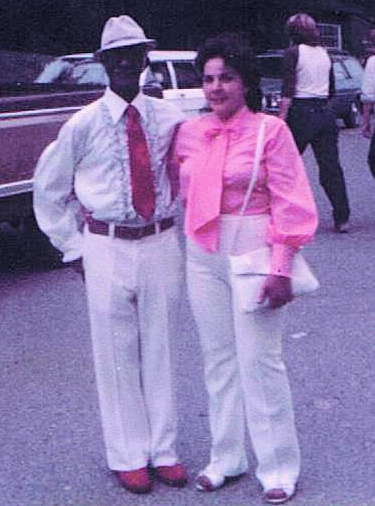
Another lucky lady gets to pose with Harry.

People loved his sincerity and gregarious nature. Such an honor it was to be photographed with Harry Hill of Bear River! Love for his town and an interest in its people earned him the title of Ambassador of Bear River. 

One of Harry’s favorite things was his bicycle, which he could be seen riding along the narrow streets in all kinds of weather, rain or shine. Another one of Harry’s favorites was a photograph of Oprah Winfrey, an autographed gift which he was so very proud of. 

Harry was an avid pool player and even had his own seat at the local Legion. 

Harry loved the ladies and he loved life. The monument by the riverside is a testament to his sense community spirit, his diligence in promoting kindness and love, and to his honesty and integrity.

*******************************************************

A teenage Harry Hill

Visit the Cherries and Cherry Carnival page to see a film clip of Harry when he was 15.

*********************************************************

MORE ABOUT HARRY HILL

This is a story of Harry Hill’s life as told by Harry Hill himself. (2003)

“My name is Harry Hill and I was born May 14, 1913, which makes me 90 years young. I have lived in Bear River Nova Scotia all of my life and there were 16 in my family.  I started school when I was 5years old at the old Oakdene school which burned down in 1934.  Not having a fire department like today, buckets of water were used to put out the fire, which didn’t work and the Anglican Church next door burned down also. Thank the Lord that the wind wasn’t blowing the other way.  Times were tough in those days, and I can remember working for 10 cents an hour.  We ate well and were always kept clean as cleanliness was next to godliness even if you were not rich.

I only remember nice things about going to school and being the teacher’s pet. At 19 year of age I left school (grade 10) on permission of my father.  School only went as far as grade 11.  I went to work at the JH Cunningham stave mill were I worked for 26 years, working in all departments.  There were a lot of people looking for jobs during the depression, and you had to prove yourself physically and mentally.  A stave is  a curved piece of wood forming parts of the sides of a wooden barrel.  There was also a cooper who was responsible for the metal rings to make the barrels.  The barrels in those days were used for holding nails and apples for instance, and wooden boxes were made for cherries and other things.  This was before cardboard took over.  Wooden barrels went to the Sydney Steel factory.  This was a thriving community area with about 1800 people and other industries like a clothespin factory.

My father, Benjamin Hill, was a master stone mason, and I went to work with my father who had worked in Halifax after the terrible Halifax explosion and he had been a stonemason foreman also.  You worked where the work was.  I worked at the Cornwalllis Naval base and at the Digby Pines for example.  Later on, I worked at building the present Bear River Post Office which is made of bricks and after th Post office was built, I got the job as cleaner, maintenance worker.  I worked at this job for 13 and a half years. Oh, there was a time previously that I had worked for the Nova Scotia Power Company for a bit over a year.

In 1956, I got the position of caretaker of the Mount Hope Cemetery, Bear River.    I worked at the Mount Hope Cemetery for 39 years which I did with great pride and honour.  The cemetery was kept in good shape at all times and many a photograph was taken of me and the grounds by people from all over the world.  It became a tourist attraction also.

I was brought up to respect God and look on life on this planet like four seasons and when the Lord wants you, you will have nothing to say about it or complain about it,  In essense, you can talk or complain all you want about the wether and death, it is the only thing you can be sure of.  I never discuss it too much but it was very difficult for me getting the gravesite ready for members of my own family, and most have moved on. Then, on the other hand, I buried people who were not very nice either and some of these I wished them a better life after.  I believe in the words of the good book and don’t mind speaking and preaching to young people of todaa on values and to have respect for life.”

Harry Hill was called by his Lord on the 9th of April, 2005, age 91.

Here are some of Harry Hill’s memories of life in  Bear River, which he talked about at a presentation at Oakdene Center in July 1997.

There were 11 stores in town including a jewellery store.

There were apple and cherry exports.

There was a stone cutting business, and a business that made memorials.

The Bear River Packett went back and forth to St. John.

There was a shipbuilding yard where the fire department is now.

Timber sold for $2.50 per hundred feet.

There were more than a 100 employees at Lake Jolly including the clothespin factory and the cooks.

Cunningham’s Mill  burned in 1934. He worked ther 26 years.

In the 1930’s depression, nothing moved for nine months.

The Lincoln Pulp and Paper was where the Legion is now.

The rate of pay for labour was 10 cents per hour for ten hour days. During the war it was $7.00 per day.

**************************************************

************************************************

For a transcript of an interview with Harry Hill go to  http://www.municipalities.com/elders/elder_harryhill.htm

We would love to add more memories of Harry Hill and any photos you would like to share.  Email thebearrivertides@gmail.com to let us know.

all contents of this  page are copyright of the Bear River Tides and Think for yourself publishing. 2012


Historic Glimpses of Picturesque Bear River: Lennie D. Wade: Part One

Published February 18, 2012 by oddacity designs

In 1908, Lennie D. Wade wrote a lovely and lengthy history about Bear River . Here is Part One.

This is the cover page:

Here are the contents: the photos have been added by The Bear River Tides, following the originals as closely as possible and with some additions.  The numbers designate footnotes.

Preface:

As much of the information herein published has been gathered from various sources, many of the statements may not be in accord with facts and the writer will be greatly indebted to anyone furnishing authentic corrections. Thanks are due chiefly to many of the older inhabitants, and to some of the younger ones who have been very kind in supplying much of the data recorded.

signed, Lennie D. Wade

Historic Glimpses of Picturesque Bear River
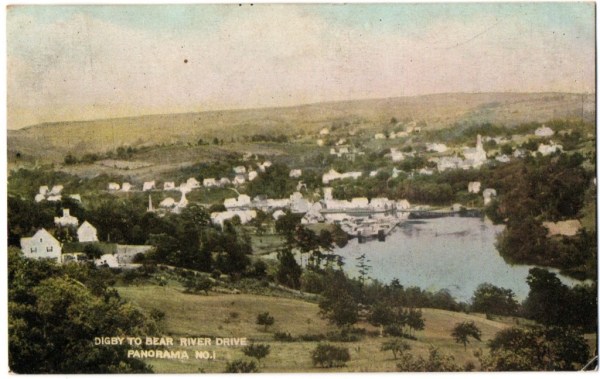
Bear River :"Jewel of the Province"looking south

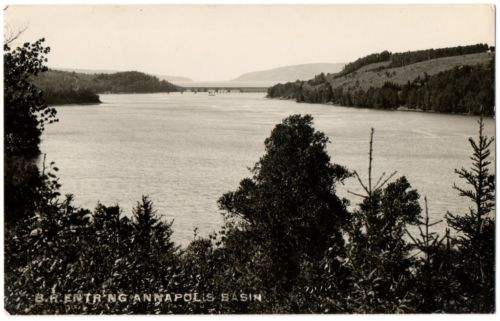
To get our first glimpse of Bear River we must go back two hundred and ninety five years, to January 13th, 1613, when a small vessel, bringing supplies to the French colonies at the head of the Annapolis Basin, was forced to take shelter from a severe snowstorm in the lee of what is now called Bear Island.

When the storm had ceased, the captain, Simon Imbert discovered near them the mouth of  a small river to which he returned after delivering his cargo. This river he explored as far as the meeting of its two branches, now known as “Head of the Tide”.  The first sawmill erected there bore his name, and a road nearby is still called “Imbert’s Hill”.
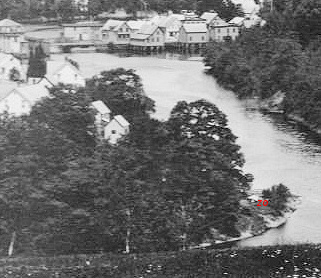
view of Imbert's Hill in foreground

As his name was pronounced “Imbare” among the Acadians, the river may have been known first as ” Imbare”  and later known as Bear River, this name being applied still later to the town which sprung up along its banks. On Champlain’s map of the this same river was known as “St. Antoine” while on Les Carbot’s map it was named in honor of one Louis Hebert, an apothecary in the expedition of De Monts.  Hebert left Port Royal in 1613 but his descendants are numerous in different parts of Canada.

It may have been from the name of either of these men that our river was so called “Bear River” or it may have been from the following Indian legend.

Many years ago when the noble red men reigned supreme as the lords of the forest, three hardy braves, each with his squaw and papoose started down from the head of the river to it’s mouth to engage in catching the porpoise, then their chief means of livelihood.Arriving at a suitable spot for a camp, the braves went off to their work, leaving their squaws to pitch the tents and prepare a meal against their return.

The squaws were busily engaged stirring the food over the fire, when they saw coming toward them, three big brown bears.  Of course, their first thought was for the papooses and they must have decided that the only way to save these babies was by giving their own lives.

In Those days every Indian woman wore a tall, cone shaped birch bark cap.  So these three squaws each rushed at a big brown bear and as the big brown bears stood up on their hind legs, mouths wide open, made a grand dive, cap first, down the bear’s throats. Whether these three big brown bears were choked to death. or whether they died from a sudden sever spell of indigestion, we do not know, but when the Indian braves returned  from their day’s work, they found only the bodies of the three big brown bears and those of the little papooses who had died either of fright or of hunger.  The latter’s bodies were quietly buried but the braves each dragged a big bron bear’s body to the edge of the river and threw it in grunting as he did so “Ugh, mooin,sisboo”
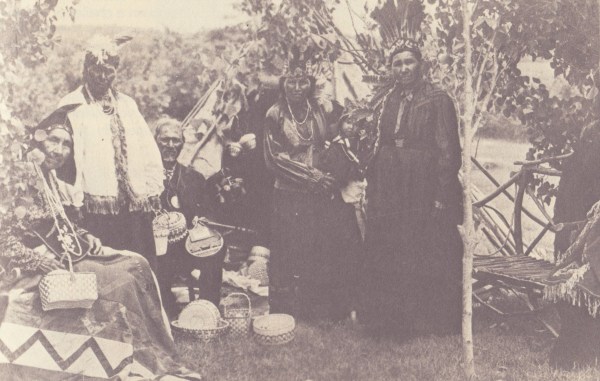
Bear River First Nations traditional dress

The reader is at liberty to judge which derivation he pleases.

As the French made no settlement along this river, we must look elsewhere for the earliest settlers.  Though a few ofthe Loyalists settled here, it is  to the Rices, Clarkes, Harrisses, Millers and Chutes who came from Granville, Annapolis and Digby, that we must look as the pioneers, with the Bogarts, Croscups, Bensons, and Crouses of Loyalist stock as co-workers.

When these people first settled here, their homes were but log houses, and the only highway, the river.  The cellar was not built under the house but was simply a hole dug in a bank or side of a hill in which vegetables etc. were stored.  The first frame house was built by a Captain O’Sullivan Sutherland in 1785, near the house now occupied by Mr. O.H. Ford.  The oldest standing house is that owned by Mr. George Tupper.(1)

Among the first to build homes on the west side of the river was Mr. Christopher Prince Harris, whose descendants still live on the old place, and about the same time, Mr. Thomas Chute, grandfather of the late Mr. H.H. Chute, commenced to clear land on the east side.(2)

It is said that portions of the Hessian and Waldeckian troops were picketed at different points outside of Port Royal. These men naturally longed for something from their homeland, so they sent back by one of the vessels for some Lombardy poplar trees.  These trees were planted a few in each place where the troops were stationed and a group of them may be seen on the road leading past our Advent Tabernacle.(3)

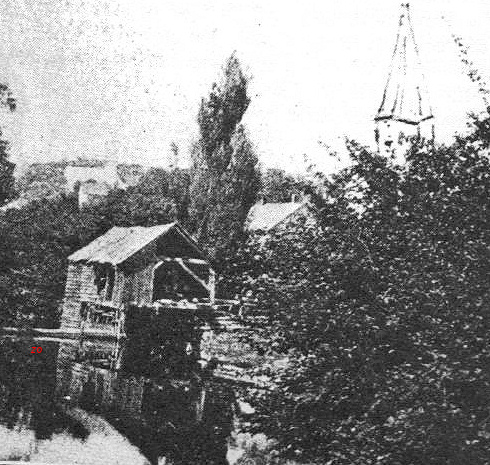
Another old landmark is the poplar tree near the site of Bear River’s first sawmill, near the brook opposite the Academy. The grandfather of Mr. George C. Harris walked from Halifax here and used a stout stick as a cane. When he reached this place he stuck it in the ground and it has gron into the grand old tree now seen.  A clause in the deed of the land on which it stands provides that it shall never be cut down.(4)

The first sawmill ; poplar tree in center of photo is one referred to in story.

Bear River has always been noted for its cherries, and perhaps it will be interesting to some to know that the first trees were brought here from England by a man named William Sutherland in the latter part of the 18th century.  They were planted on the upper  flat of  Clarke’s Marsh, where is now the Y.M.S.C’s tennis court.(5)
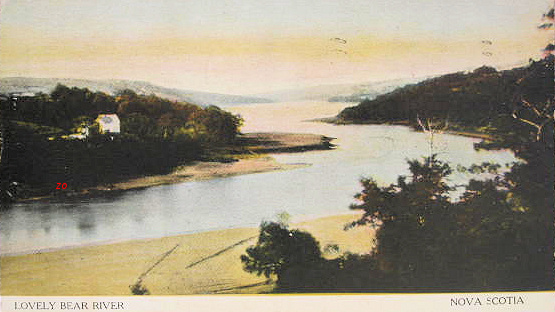
the point of land in the center of photo is the upper area of Clarke's marsh, now the Millyard.

The oldest one was cut down about 70 years ago and had grown to an immense size.  There is a story to this effect- a curse will be put upon the people and a blight upon the trees if a monument  be not erected to the memory of him who first brought them here. There certainly seems to be a blight upon the trees.  Notwithstanding this fact, there is generally held during the cherry season a festival throughout the  country as “Bear River Cherry Carnival”  On this eventful day, crowds gather from far and near to witness calithumpian parades, sports of all kinds and to enjoy a regular feast of cherries of which there is usually a good supply.

an early Cherry Carnival

Excursions run that day and all through the season, by steamers from Digby, Annapolis, Westport, Centerville, Margaretsville, and many people, both tourist and native, avail themselves to visit our village and to carry away quantities of the fruit and a report of a general good time. (6)

Formerly our town and vicinity was  included in the township of Clements, all forming a part of Annapolis county.  This township was granted to and created by Ge0rge Sutherland and two hundred and forty others, members of disbanded German troops, who came to Nova Scotia in 1783.  These men  were also known as the Hessians and the Waldeckians, and we have living in our town the descendants of several of them. Christopher Benson’s name was on the list of 1784, also those of Capt. Donwe Ditmars, John Morehouse, and Francis Ryerson.  Stephen Ryerson, a son of the latter,was the prototype of the character of “Stephen Richardson” hunter, trapper and humorist whom Haliburton has so well described in one of his works (probably “Old Judge in a Colony).

Some of the first roads built leading out of Bear River were (1) from Bear river to Allain’s Creek in 1787. (2) from Bear River to Moose River in 1800.  (3) from Bear River to Annapolis in 1801.  The first bridge on the site of the one now crossing the river at the village was built in 1808, while the present one was commenced in May 1886, and finished in December of the same year at an approximate cost of $10,000.

An education was not very easily obtained in the early days of our town.  At first a few women made it their business to travel through the country-teaching a few weeks in each place.  But the first regular teacher was William Nicholl, an Englishman who came out from the old country about 1800.  One of the “copy books” used in his school is in the possession of the  writer of this history.

The first building in which he taught was a log house, standing between where is now the post office and G.I. Brook’s shop.(7)  Since the time of that building, schools have been kept in different places, including the Temperance hall(8) and an old meeting house, until the law was passed in 1864, when schools were run by taxation, and the houses in both the Hillsburg and Bridgeport sections were built.  The house in the latter section has been torn down but the Hillsburg one still stands and is used as a sail loft by Mr. Russel. In 1892 these two sections were united, and a  new building built on the Annapolis side of the river.

The original Academy, built 1892

We now have one of the finest schools in the country, conducted by a very worthy principal, and having six departments, a library, manual training benches, and an excellent laboratory.  Our Town Hall, where all concerts are given etc., is on the third floor.

It might be well to say here that the first Postmaster was the William Nicoll referred to previously and the “office” was a small box in his schoolhouse.  Until 1845, or previous to this time, no regular system of mails had been established, occasionally the mail having been carried all the way from Halifax in some’one’s coat pocket.  But now (1845) weekly mails were established between Halifax and Digby  via Annapolis.  A “courier” left Halifax every Monday afternoon about  two o’clock, and weather permitting, reached Kentville the following Wednesday.  Here he met the “courier” from Digby, mails were exchanged and each started on his homeward trip.  As the journey was made on horseback, the mails were carried in the saddlebags.

When the mail had reached Digby, the Bear River Portion was entrusted to anyone who happened to be going that way.  In a similar manner, the mails were taken to and from Yarmouth.

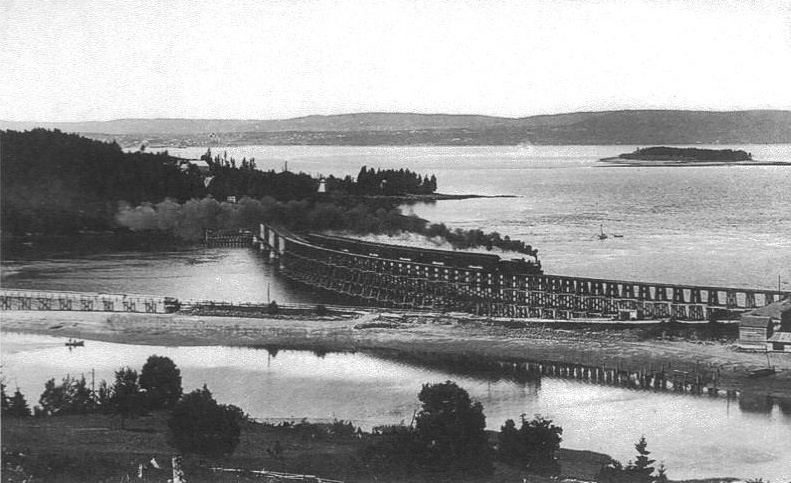
Annapolis became connected with Windsor by railroad in 1865 but it was not until September 29th, 1879 that the road was completed between Yarmouth and Digby.  At this time a line of coaches connected Bear River with Digby (10 miles) and Annpolis (16 miles, the “Missing Link”  as it was called, between Digby and Annapolis was   completed in 1891, when the trains were enabled to nake a through trip from Halifax to Yarmouth, this completed line being now known as “the Dominion Atlantic Railway”

Train crossing Bear River bridge early 1900's.

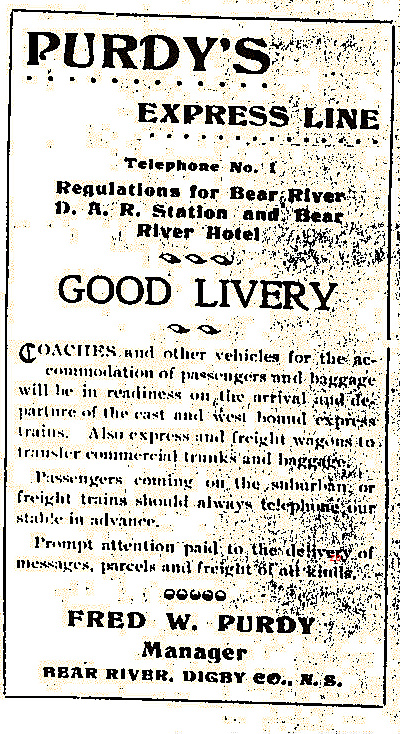
We now only have a short drive of four or five miles from the town to Bear River station.  There are so many beautiful bits of scenery on this winding road by the “Rhine of Nova Scotia” that when one is comfortable seated in one of F.W. Purdy’s up-to-date turnouts,one is apt to wish the drive much longer.(9)

The probabilities are, however, that before another ten years have passed, we will have a railroad of our own, connecting us with the other lines.  Several surveys have been made and our esteemed citizen, Mr. J.V. Thomas, has been instrumental in promoting the work, thus far.(10)

In 1837, the counties of Digby and Annapolis were separated, our river forming part of the boundary line between them.

The river divides the two counties: Digby and Annapolis

The ten years between 1831 and 1841 seems to have been the ” busy day” in the growth of Bear River town.  During that time, the first vessels were built and five churches were established.  Where now stands the greater potion of the business part of the town on the east side of the river, was then marshes and mud flats, the river flowing right up to where Mr. Phinney’s harness shop and the custom office now are(11)  In 1832 the first vessel, a schooner called the “Hornet” was built and launched on the present site of the Union Bank of Halifax.There were shipyards all along the river, from one down at the ‘Creek” at the foot of Chisholm’s hill up to the “Head of the Tide”.  Since that year, there have been built about 115 vessels, with a tonnage of 20,932 net. The largest one ever built was the  “Tamar E Marshall”, 1270 tons and the last one built was the “Castano”, in 1901.
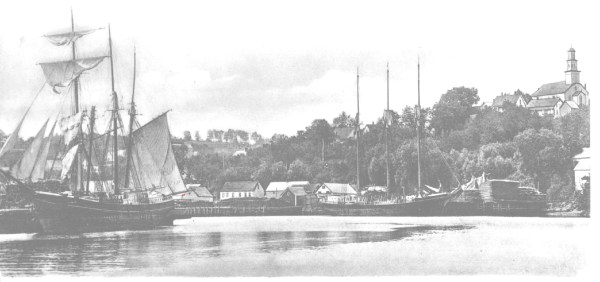
examples of some Bear River ships

Up to 1895, shipbuilding was one of the leading industries of the place, but since then it has almost ceased.  We have, however, a set of ships’ blocks, where a vessel may be repaired from almost any damage.(12)

Footnotes:

(1) This would be the house on the corner of Tupper and Upper River Rd. recently owned by Hoppy Hopkins. That it is the oldest standing house would be disputed by many older residents.

(2) The Chute family owned much of the land in the area surrounding what is now the Chute Rd.

(3) This would be the area on River Rd. near the Head of the Tide.  The former Advent Christian Church still stands on the right as you travel up the road from the firehall.

(4) This would be across the street from what is the United Church.

(5) The trees were cut down when the sawmills were built on this flat; now the Bear River Recreational Millyard.  However, Bob Benson the current owner has discovered that there are new cherry trees growing from the roots of the trees that were cut down, and is protecting and nurturing them.

(6) See the page/post of Cherries and Cherry Carnival on this website for more details.

(7) The author is referring to the buildings that were destroyed by fire in the 1970’s that were next to the building housing Ali’s Meat Market on the Digby side of the river.

(8) the Temperance Hall was built just south of  the Baptist Church where there is now a parking lot.

(9) There was also the Yorke Livery service which also ran between town and the railway station.

(10) Unfortunately this never happened.  We wonder if it had any effect on the downturn in the Town’s fortunes. Mr. J.V Thomas was listed as having a business in lumber, shingles and lathe, in the business directory of Bear River 1892.

(11) According to old maps of the village, this would be where the Wharf St. begins, next to the Legion building.

(12) This was probably found in the Rice’s shipbuilding yard  which was located where the Firehall now stands.  It was the last remaining shipyard in the village at the time this account was written.

A Family Heirloom

Published February 7, 2012 by oddacity designs

The Ditmars, a Loyalist family who came to Nova Scotia in 1783, left their mark on the Clementsport area in many ways, and inadvertently made history in a small but distinctive manner.

Known for their entrepreneurial spirit, the Ditmar’s occupied the land which is known today as Clementsport,  where they were involved in farming and  mercantile trade.

Sometime between 1902-1910, Mary Vroom, (Mrs. John Fraser) of Deep Brook purchased a  cup and saucer set made in England by Tuscan China at Ditmar’s General Store. Later, Mrs. Fraser moved to the States, taking the set with her.

Years later, in 1967, Mrs. Fraser’s daughters Helen and Priscilla,
presented the china to the eldest daughter of J.R Ditmar with the agreement that the set would remain in the family of the late Mr. and Mrs. J.R Ditmar.

This slideshow requires JavaScript.

The Bear River connection to this story is this:  the artwork on the cup
depicts a train crossing the Dominion Railway Bridge at the mouth of the
Bear River, taken from the Deep Brook side of the bridge. The artwork was a reproduction taken from the photo of a well known Bear River photographer, Ralph Harris.

Dominion Atlantic Railroad Bridge Bear River N.S.

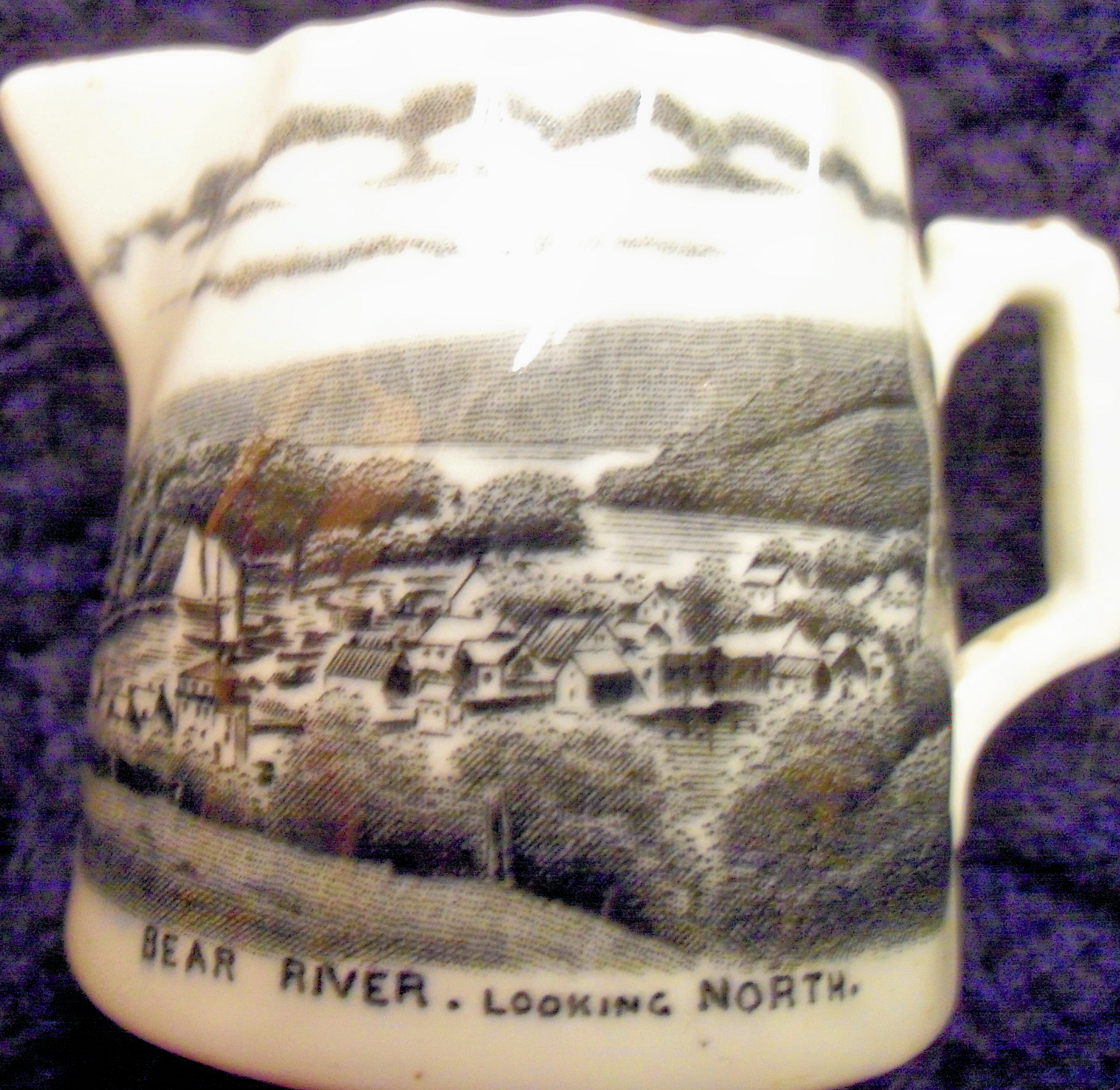
There was a large selection of souvenirs with pictures of towns  in those days, just as there is now.   Here is another example of a Bear River momento.

And here is the original photo…..

This little creamer was found on e-bay from a seller in Boston. We don’t know the story, but someone must have enjoyed their travels to Bear River enough to want to keep this souvenir for a long time.
The Concept of Tea

Teacups were an important commodity; a mark of good taste and civilization. Women coveted them and were proud to serve well brewed tea in lovely bone china cups with dainty sandwiches to their friends.  Stories were told, feelings were shared and gossip was exchanged over many a cup of tea in a bone china teacup. It was a time to relax and enjoy.

In 2009, the  BR Historical Society hosted an exhibit of tea cups that were contributed for the occasion by local women who had stories and memories based on the cup. Maybe tea cups represent a connection to a time and place that would be lost otherwise.

Alas for another lost art of in- person socialization.

Anyone with souvenir items of Bear River they would like to share on this website, email thebearrivertides@gmail.com.

Do you have a special teacup and a story?  Let us know and we’ll add it to the website!

Thanks to Angela Mc Mullen for the Ditmar contribution.

all material copyright 2012 of The Bear River Tides and Think for yourself Publishing.

Cherries and Cherry Carnival

Published February 4, 2012 by oddacity designs

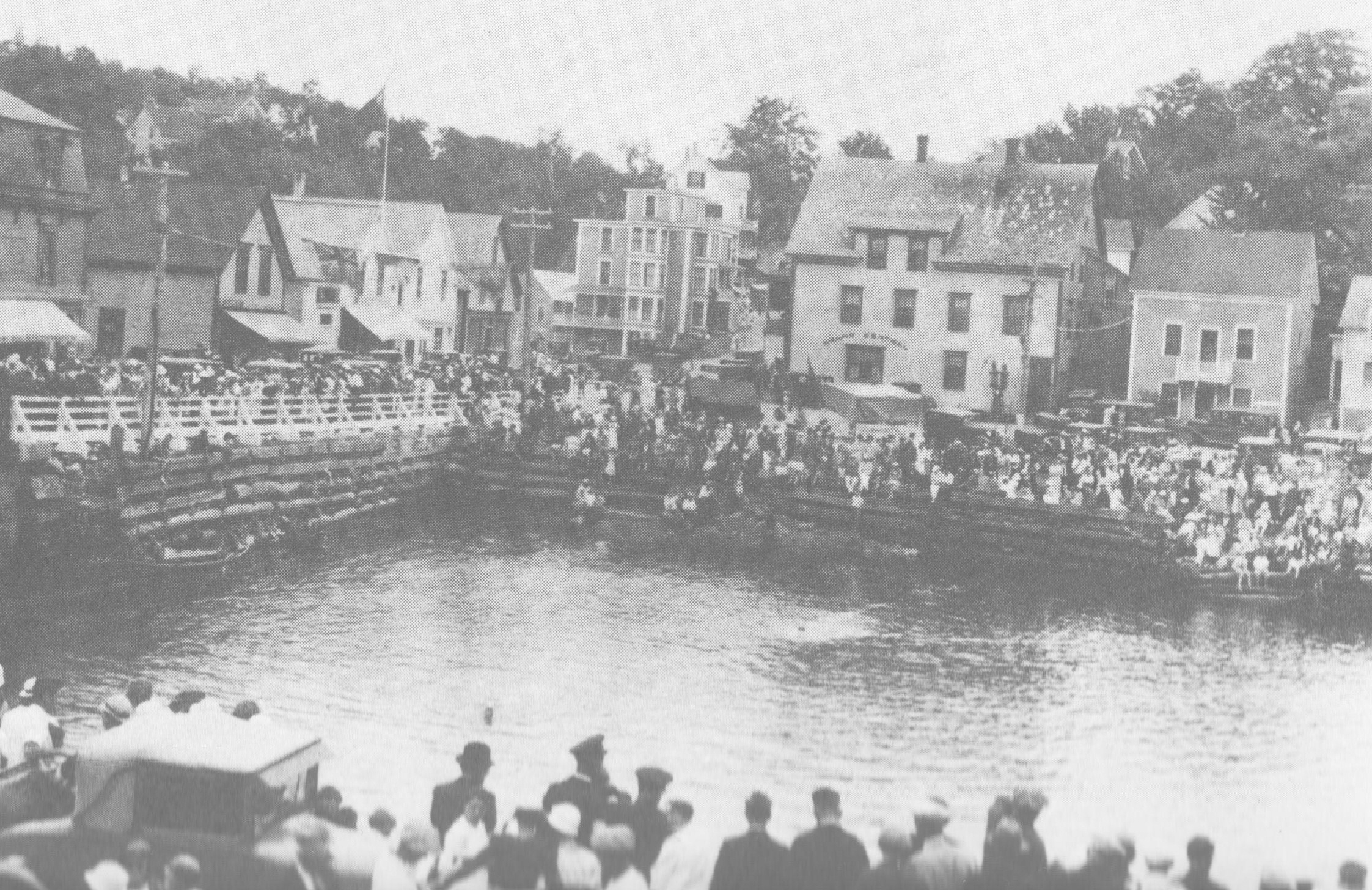
For more than 100 years,since 1894 in fact,  the village of Bear River has celebrated a festivity known as Cherry Carnival on the third Saturday of July.   Cherries were once a mainstay of the agricultural component of  Bear River and the village was quite famous for the quality of these fruit.

cherry orchard 1910 photo by Ralph Harris

Families from outlying areas would arrive by the truckful during cherry picking season and buy the rights to pick a tree, or even two. Unfortunately, the cherry orchards were wiped out buy a blight in the 1940′s, but the lack of cherries never stopped the village from having the cherry carnival.

t

It is still a huge event for the town, sponsored by the volunteer fire department as a fundraiser, and known far and wide as having some of the best fireworks in the province.

Grand street parade, 1920. Grand Central Hotel in background

The grand street parade was a favorite subject for many photographers over the past century.  Here are just a few.

Grand street parade 1925
and this one from the 1930’s

The Grand street parade often gave residents a chance to show off their alter-egos…

even the lumberjacks got into the act

…of course prizes were always awarded!

Nowadays, the Cherries are brought in from Ontario or down the Valley, and the Hooplala isn’t quite as overwhelming as it once was. However, the volunteer firemen of the Bear River Firehall are to be commended in their efforts to keep this one village event alive and the hours of hard work put into the organization of Cherry Carnival  should be appreciated with generous donations on Carnival Day.

As for the fireworks…there are none better in the province and that includes Halifax.

And now for the real icing on the cake! Angela McMullen has discovered this link which is a film about a trip to Bear River on Cherry Carnival in 1928.  The part about Bear River starts at the 8 minute mark, and that really looks like it could be Harry Hill showing off, or maybe one of his brothers.

Enjoy!

This slideshow requires JavaScript.

all contents on this page are copyright to Think for Yourself Publishing and the Bear River Tides. 2012